Persistent symptoms months — or years — after a concussion. When standard care said you had plateaued.
VALIDATION
When the concussion was supposed to heal a year ago.
You were told the standard line: most concussions resolve in three months. Yours didn’t. The headaches still come. The brain fog still lifts and falls. The dizziness still finds you. And the message you keep getting — from primary care, from the original ER, sometimes from a neurologist — is that there is nothing more to do.
That is the wall we are built to take patients past. Post-concussion symptoms beyond the one-year mark are usually network dysregulation — vestibular, autonomic, oculomotor, cognitive — that was not fully addressed in acute care. It is measurable. It is treatable. And there is more to do.
WHAT IT IS
What post-concussion syndrome actually is.
Post-concussion syndrome (PCS) refers to a constellation of symptoms that persist beyond the expected recovery window after a concussion or mild traumatic brain injury — typically beyond three months. The symptom set is heterogeneous: cognitive (brain fog, memory, word-finding), vestibular (dizziness, balance), oculomotor (visual motion intolerance, convergence problems), autonomic (dysautonomia, exercise intolerance), and affective (anxiety, depression secondary to the injury).
When PCS persists past one year, it is sometimes called persistent post-concussion syndrome, or PPCS. The mechanism is functional rather than structural — standard imaging (CT, MRI) is typically normal. The dysfunction is in how brain networks are talking to each other, not in any single lesion.
HOW WE DIAGNOSE
Starts with a qEEG brain map.
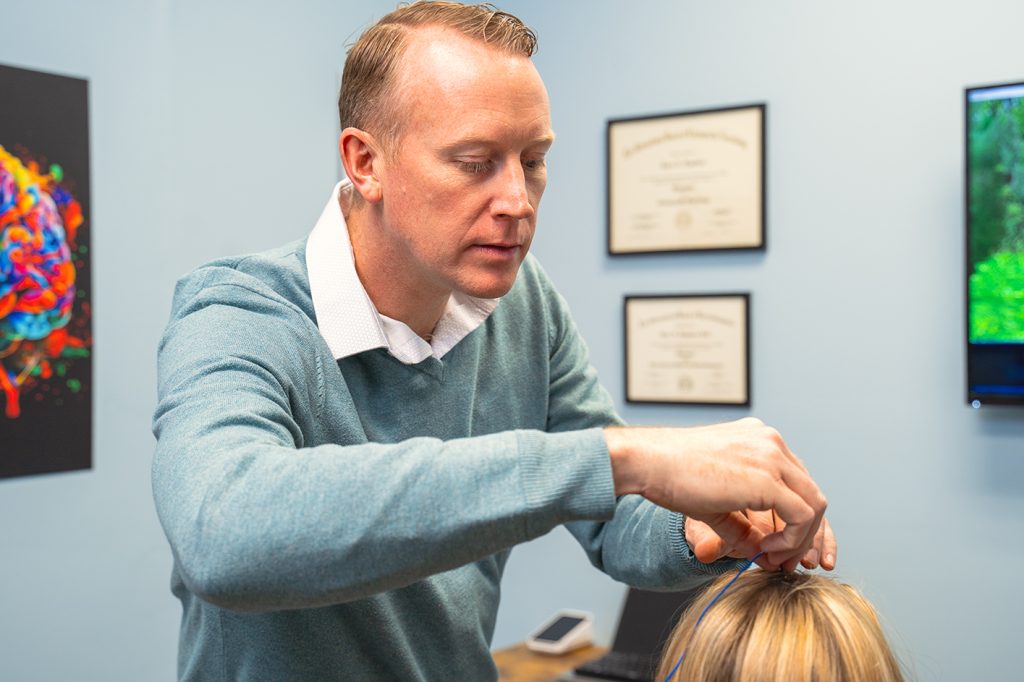
Every PCS assessment at Restorative Neuro starts with a full intake, a focused neurological examination, and a qEEG brain map. The qEEG quantifies your brain’s electrical activity and surfaces patterns of network dysregulation that structural imaging cannot show. We pair that with validated symptom inventories (PCSS), oculomotor and vestibular testing, and autonomic assessment as indicated.
You leave the first visit with a written plan: what we measured, what we found, what we will treat, in what order, and when we will re-test against your baseline.
OUR APPROACH
A modality stack matched to your specific findings.
Modalities selected from your specific qEEG findings. Sequenced by phase. Re-measured against your baseline.
A phased protocol, not a sequence of appointments.
Most PCS protocols run 10–20 in-clinic sessions across 4–8 weeks, with a re-evaluation built in at the midpoint. Some patients are travel-in for intensive 2- or 4-week blocks. The exact length is set after your assessment, not before.
If treatment is producing measurable change against your baseline, the plan continues. If it is not, the plan ends or the plan changes — we say so at the re-evaluation. We publish our non-responder rate. See Patient Results.
Assessment
PHASE 01
Full intake, neurological exam, qEEG brain map. You leave with a written treatment plan and an honest assessment of whether this clinic is the right setting for your case.
Targeted Treatment
PHASE 02
Phased course of treatment from our modality stack, selected for your specific findings. Progress re-measured against your baseline at defined intervals.
Final Review
PHASE 03
Closing re-evaluation, written outcome summary delivered to you and your referring clinicians, and a home program calibrated to keep gains stable.